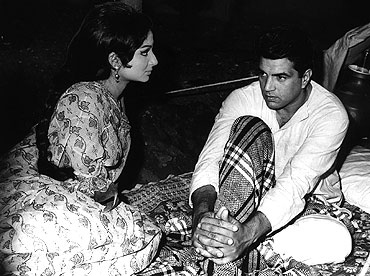
5 hindi movies castings that misfired badly...

1 comments


They say, in order to be successful, you need to be at the right place at the right time, and if we talk about movies, especially Hindi Movies, this seems to be more than mere conjuncture. Almost every big star had their big moment, when any big star, at their prime, left a role that was unique/bold as per their times and thereby paving way for a relatively new comer to show his/her skills, e.g. Amitabh Bachchan got the famous role of Zanjeer after the role was rejected by almost every big star at that time including Rajesh Khanna and Dev Anand.
Today, we will not talk about these cliched instances; rather we will look at the other way around. Let’s see all those movies/roles which were meant for someone else and the roles were offered to another actor/actress and the later couldn’t do justice with the tailor-made roles.


#5: Amitabh Bachchan/Jackie Shroff : King Uncle
This 1993, Rakesh Roshan directed movie was about a rich guy who hate poor people and kids because of a traumatized childhood. The role of the protagonist was earlier offered to Amitabh Bachchan. He turned down because of his semi-retirement in mid 90s. AB did come back from his retirement and after some forgetful movies like Lal Baadshaah, acted in various movies as an elderly strict father with strict rules only to melt down in the climax, similar to the plot of King Uncle. Had he acted in this movie, he would have saved the Indian audience from an awful looking Jackie Shroff with the worst ever moustache-job and a failed attempt of rib-tickling humor. May be this could be the first confrontation in Hindi movies between the then lesser known actor SRK and AB!


#4: Karishma Kapoor/Twinkle Khann: Mela
Although this is a proven fact that the 2000 flick Mela was awful in every sense and even an actor of the caliber of Aamir Khan could not save it from sinking, but here is a unique trivia: Director Dharmesh Darshan’s original choice for this movie was Karishma Kapoor, the trio (Dharmesh Darshan, Aamir Khan, Karishma Kapoor) previously collaborated for the Superhit Raja Hindustani. Kapoor left the project citing date issues and so Twinkle Khanna was roped in. Dharmesh Darshan was so much obsessed with Karishma Kapoor’s look in Raja Hindustani that he made Twinkle Khanna to wear the same clothes and wigs. Twinkle Khanna clearly lacked all the oomph and latkas and jhatkas for a role which was never meant for her thereby contributing for the biggest disaster of that year!


#3: Aishwarya Rai/Manisha Koirala: Mann
This 1999 movie, directed by Indra Kumar, was earlier offered to Aishwarya Rai. She could not do it because of prior date commitments, after which the role went to Manisha Koirala. Despite having a interesting plot, Aamir Khan’s presence and a good opening, the movie was a Box-Office Average courtesy a lackluster performance by the aging superstar Manisha Koirala. Many trade analysts attributed the fact that the movie lacked fresh appeal. Cinema goers could not digest a rich Casanova failing for Manisha Koirala. Interestingly, at the same time Aishwarya Rai’s Hum Dil De Chuke released and it fared well!


#2: Kajol/Rani Mukherjee: Kabhi Alvida Naa Kehna
This 2006 Karan Johar movie was earlier offered to Kajol, which she said no, because her character was shown to do infidelity with her husband. The role was then passed on to Rani Mukherjee who was supposed to play Preity Zinta’s character. According to Karan Johar, the casting and infidelity factor were written keeping in mind an elderly lady being married to a young Abhishek Bachchan and a relatively younger lady married to ShahRukh Khan and thus the audience will more understand why their respective marriage is not working. This movie is a classic example of casting went wrong.


#1: Sanjay Dutt/Anil Kapoor: Trimurti
The 1995 Shubhash Ghai multi-starrer movie was supposed to star Sanjay Dutt and after he went jail in TADA case, the role was given to Anil Kapoor. This was a role tailor-made for Sanjay Dutt, as someone who doesn’t believe in ideologies, sets his own rule, has his own style quotient and even the antagonist of the movie fears him. This role had Sanjay Dutt written all over it. 


Bonus Round:
If you think, this happens with only the actor/actress read this:

Shekhar Kapur/Satish Kaushik: Roop Ki Raani Choron Ka Raja
The movie Roop Ki Rani Choron Ka Raja, was earlier supposed to be directed by Shekhar Kapur, following their successful collaboration in Mr. India. Once he left midway, Satish Kaushik was roped in to complete the movie and as a result the movie suffered with poor screenplay and script and was a box-office disaster.


Hope you liked this trivia. Post your views in the below comments section. Subscribe to the Filmistani facebook page for more such interesting trivia.


6 Great Women Characters in Hindi Cinema

7 comments

Statutory warning : This list is by no means exhaustive. This is a reflection on the part of the author of the women characters who have wholly fascinated him in Indian Cinema.


The sad lot of women in cinema is due to them being treated like a) Wall Paper b) Scenery (see : wallpaper) c) sex objects d) objects. Thus films with women in powerful central author-backed roles come few and far in-between (and Madhur Bhandarkar's films don't count, because they a-suck). Thus there are few opportunities for strong women characters getting portrayed on screen. There are of course numerous (and yet too few) instances of such celluloid sizzle, and below is a list of six such instances wherein the lady in picture (literally) packed a punch.

6) Sweety (Kaminey)


In a film full of anti-heroes, Sweety was the ultimate anti-heroine. She was perhaps the first 'Overly Attached Girlfriend' before the meme became popular. She literally cons her naive boyfriend into getting her pregnant, then compels him to get married to him, and before he can take another breath she ensures that her honeymoon is completely planned. Then she goes into an endearing jig during her own wedding


But make no mistake, Sweety isn't some back-stabbing bitch of a character. She really loves her boyfriend, and when she finds out that her own brother (a big shot Don) is about to murder the hell out of him, she dons this avatar


She sprays bullets across her bhai's entire gang and doesnt hesitate before pulling the trigger against her evil brother (unfortunately she runs out of bullets by then). Sweety was an interesting foray into a different female character, she was all that heroines aren't supposed to be, and this is what makes her different.

5) Paro (Dev D)

Speaking of women dancing at their own weddings, we present to you Paro :


Picture this first in Hindi Cinema. A girl who outdoes her boyfriend in sexual banter (at long distance in ISD), and who plans their sexual encounter (instead of acting coy and saying yeh sab paap hai etc), never before and never after have we seen a girl in hindi cinema carrying a mattress on her cycle in the field for a planned sexual tryst with her doomed lover.

And when he dumps her for reasons stupid, she promptly dumps him back (to coin a phrase) and tells her that she is getting married to someone else. When the hero asks if she is making fun of him for doing this, she says, 'Nahi, tumhari auqat dikha rahi hoon'.

And she too does an impromptu dance at her wedding thus


Later in the film Paro goes and tries to clean up the act of the self-destructive DevD, but draws a limit at love. She frustrates his sexual attempts and leaves him, her only motive being his well being (both physical and clinical), she has moved on and she is strong enough to leave the loser who left her.

4) Mammo (Mammo)

Moving onto a totally different kind of character, we present to you a film which shows what Shyam Benegal was capable of during his hay days. It starred everyone's favourite grandma in the titular role of Mammo


It is part of Benegal's Khalid Mohammad trilogy (the other two movies being Sardari Begum and Zubeida), and it tells the story of a woman who has been forced to move to Pakistan post partition, but once her husband dies she moves to Mumbai to live with her sister on a temp visa. She is truly Wodehousian in her ways, and gets by with a few bribes (to the neighbourhood Police Inspector, so that he extends her visa indefinitely), some lies (to protect her grandson and to be his cool grand aunt) and a lot of laughter (to generally improve the lot of her sister and her grand-nephew (by making her life happier, and sharing with the boy among other things, a packet of cigarettes).

Unfortunately once the neighbourhood inspector gets shifted, she is deported back to Pakistan, but being the artful character that she is, she fakes her own death and comes back to India permanently.

3) Vidya Bagchi (Kahaani)

Kahaani is one of the best movies to come out of our cinema in the past two-three years. There, I said it.


And the biggest reason for that is the character of Vidya (Bidda) Bagchi, so convincingly portrayed in the film by Vidya (Bidda) Balan that she fools every character in the film (including the friendly neighbourhood policeman) and everyone in the audience

Dreamboat and 'simple' Policeman
She even makes mincemeat out of the cunning Khan, and most of all when in the end at the big reveal she leaves entire theaters gasping.

We see, love, caress, explore Calcutta through her eyes and her painful story, and once when the story ends we are loathe to leave the hall because we want to see more of Vidya Bagchi literally kicking ass on the screen.

2) The Village Women (Mirch Masala)


The central character in the movie was the lovely Smita Patil, it was a story set in Colonial times about a village headed by a tyrannical subedar (Naseer sir) who believes that all he surveys is rightfully his.

And this includes the lovely Smita Patil. During the course of the film and the subedar's oppression, the heroine becomes the object of illicit desire of the Subedar. He promptly gets slapped by her for his advances, as one thing turns to another it culminates into her taking refuge in a Mirch factory while the Subedar literally stands outside the doors with his entire army. Because he is one of those stubborn idiots who likes taking things to the extreme.

The entire village gets caught in this with most of the men folk asking the heroine to give into the Subedar to ensure no harm comes to the rest of the women, and this is where the rest of the women come into picture. 

What follows is the entire village women (consisting of a stellar supporting cast of the Pathak sisters and Deepti Naval) using one of the most novel methods at defense/retribution. Taking advantage of the fact that the heroine is at a mirch factory, the women bomb the subedar and his army with raw spices leaving a flabbergasted subedar helpless.

1) Bandini (Nutan)


Bimal Roy had a penchant for presenting strong female characters on screen. And in his films, Bandini reigns supreme. It had the heart-breakingly beautiful Nutan in the title role


In fact Nutan was so pretty that one can easily forgive her for Mohnish Behl. The film was also blessed with everlasting songs (Mora Gora Ang Le le, Mere Sajan hai us paar)

The movie is about a woman who gives up most of her life and serves stoically a prison sentence. Circumstances hurtle her towards committing a crime which she commits and then owns up immediately. She serves out her predicament and leaves prison when her term gets over with her conscience clear. She finds love (or love finds her) in Prison in the form of a young and handsome Dharmender who plays a jail doctor.

Fortunately/Unfortunately she bumps into the lover she committed the crime for, and it turns out that her lover sacrificed their love life for the good of the nation. In the end she decides that love can be given another chance.


These are just a few of the great women characters in our cinema, please feel free to add your own to this list in the comments section below.

Five Notable Bhojpuri Films

1 comments

Bhojpuri is familiar to almost half of the Hindi speaking north India population. Every now and then Hindi films have a Bhojpuri-speaking-UP-Bihar-ka character. Yet the Bhojpuri film industry suffers from lack of quality, plagiarism, vulgarity and what not.
                                But that has not been always the case. Like Hindi movies, Bhojpuri films too have had a golden past (right from the inception of industry in 1963). There have been absolutely remarkable films over the years before the recent decadence. Recently Bhojpuri Film Industry completed it's fifty years. Today we'll walk you through some of the pieces of such cinema which got buried in the sands of time


1. Ganga Maiyya Tohe Piyari Chadhaibo


                   The first Bhojpuri movie, this was the brainchild of Nazir Husain and suggested by Dr. Rajendra Prasad (yes, the then president of India). Based on a sensitive issue of widow remarriage and made with a budget of Rs. 5 lakhs, this film went on to become a super-duper hit. It even inspired Raj kapoor to make 'Teesri-Kasam'.

                                                                         Title Song

2. Bidesiya


              Considered among classics, and released in 1963, Bidesiya is yet another rooted film fragrant with delightful folk music. The titular role was played by Sujit Kumar (bhojpuri legend) and this movie paved the way of him attaining greatness. The heart touching story of a upper caste thakur and a lower caste girl was something not even imaginable during that time.  

hasi hasi panva khiawale be-imanva


3. Dangal


             Centerd around a bout of wrestling, Dangal was a path-breaking movie in many aspects. Firstly it was the first color bhojpuri film. although it took sometime for industry to release color movies, the start could not have been better. It was Nadeem-Shravan's first music assignment. It brought the duo into highlight log before they came in limelight. The songs were very catchy and one song in particular is fresh even today in minds of bhojpuri film lovers.

Kashi Hile Patna Hile


4. Balam Pardesia 


                              Balam Pardesiya is a treat to watch. A light film with beautiful songs which went on to become cross-over hits. Being made in 1979 this movie honestly depicts the folk color. Songs 'Gorki Patarki Re' and 'Chadhte Phalgun' were sung by Mohd. Rafi and are the two best in the movie.

Gorki Patarki Re
chadhte fagun jiyara

5. Hamar Bhauji


Coming into '80s, when Bhojpuri Cinema's decline had started, this movie had a number of notable actors including Shri Ram Lagoo, Tanuja, Sachin. It was tough for films to taste success that time, still this one stood out. Songs of this family drama were sung by the likes of Udit Narayan and Suresh Wadekar.


10 Unforgettable Salil Chowdhry hits

0 comments

The golden era of Bollywood was ruled by many extraordinarily talented artists. Perhaps not as well known as the rest of his contemporaries, Salil Chowdhry was definitely one of them. Accomplished on the flute, esraj, violin and piano, Salil da was also a poet and a playwright. His strength was in the fact that he mastered different genres and instruments always innovating in his own compositions. He was greatly influenced by his father who used to stage plays with the villagers and the labourers reflecting the plight and social conditions of the time. Around the same time he joined the Indian People Theatre Association(IPTA) which eventually led him to the world of Cinema. Starting his career in Bengali cinema, Salil da made his mark as a music director with his very first Hindi movie Do Bigha Zameen. And then there was no looking back. Immortalized in the cult classics, the fun numbers, the classical masterpieces, his music still garners the same attention as it did years ago.
The following are some of the most unforgettable hits that have cemented their place in the record books of Indian Cinema as musical treasures:


Mausam beeta jaye, Do Bigha Zameen(1954)
This song sets the tone for the rest of the movie. And when the rest of the movie is Do Bigha Zameen, that is a huge statement. It grips your attention right at the beginning and makes sure you feel like you are part of the story. This was Salil da’s first Hindi movie and he composed the music along with writing the story. It won the international prize at Cannes film festival that year.


Dil tadap tadap ke, Madhumati(1958)
Dilip Kumar, Mukesh, the walk through the hills, not to mention Vyjayanti mala and Lata Mangeshkar, this one had a lot going for it. Probably one of the best musical hits of its time Madhumati saw both Salil Chowdhry and Lata at their peaks with Aaja re pardesi and Chadh gayo paapi bichhua. But this song of course takes the cake thanks to Mukesh and Dilip Kumar.


Jaago mohan pyare, Jagte Raho(1956)
With this song Lata Mangeshkar set a standard that probably even she couldn’t reach again, let alone others. The huge orchestra, the chorus, Salil da was an accomplished arranger. He brought everything together and made sure every aspect fit in its place like in this song where so many elements come together to form a beautiful sound.


Ae dil kahan teri manzil, Maya(1961)
This is an amazing mixture of Indian and western classical styles. Lata’s interlude lingers in your head long after you’ve heard the song. And Dwijen Sen who sounds strikingly similar to Hemant kumar combined with the incredible Devanand only makes it more soulful.


Na jaane kyun, Chhoti Si Baat(1975)
Chhoti si baat was a beautiful little poem in motion that seemed to have jumped right out of our lives. And the music was in perfect rhyme with the performances, the story, the dialogues, this song being the cherry on top. This song is an example of the amazing Salil-Lata combination which created musical gems every single time.


O sajna, Parakh(1960)
This is probably one of Lata Mangeshkar's best works. Also the composition of this song is not the traditional Antara-mukhda style but something called the sanchari format which Salil da had so much expertise of that other bengali music directors hardly ever tried this format fearing their comparison with the master.


Zindagi Khwab hai, Jagte Raho(1956)
Another timeless classic that was way ahead of its time in terms of the lyrics as well as composition. Performed by Mukesh, this song shows again how vital music is to Indian cinema. The right song at the right time and you end up feeling exactly what the characters are feeling.


Aake seedhi lagi dil pe, Half Ticket(1962)
Kishore Kumar’s rendition, Pran’s dance moves, this is the stuff that legends are made of. I shudder to think of a Bollywood without this song. Kishore Kumar apparently convinced an apprehensive Salil da that he would sing both the male and female parts of the song and that is how ladies and gentleman, a classic was made.  


Ae mere pyare watan, Kabuliwala(1961)
This is a song that we’ve all heard repeatedly from time to time. While the movie Kabuliwala in itself is a masterpiece, this song stands out thanks to Balraj Sahni, the cult status and of course the voice of Manna da moving like liquid gold.


      Zindagi kaisi hai paheli, Anand(1971)
Anand was a movie in which everything seemed to work at perfection. Hrishikesh Mukherji shot this film in just 28 days. The soundtrack in itself is nothing short of  a work of art. This song was first proposed as the background for the titles but Rajesh Khanna convinced Hrishikesh da that it would be a shame to waste such a good track as in those days the title tracks weren’t played much on the radio. Manna dey, Rajesh Khanna, the ocean and the saxophone, this song just never gets old.  


Kahan Gaye wo Naag - Copied from PFC (Subrat was the writer)

0 comments

Since Passionforcinema lost its existence long time back. I am trying to preserve the heritage of my favorite movie blog of all time. here's one of my personal favorite from the collection of those gems. Now if anyone is wondering how I got access to this, then I have been keeping it preserved for a long time but in case my computer gets a format, it will be lost forever. So here it is

I miss my evening snakes (Gujju pun unintended) and entertainment. I mean where are the ichchhadari nags and nagins these days? And those legends that surround them. Like so many other trivial details, I remember the day when I saw my first snake. To be factually correct, I barely saw its tail but I vividly recollect the conversations around me as the senior boys from Grade 5 milled around me. The whole brouhaha was about whether the Nagin had spotted any of them in which case she would have captured their mugs in her eyes and will later wreak vengeance on them. As a 7 year old, this left an indelible impression on me and led me to believe all nag-nagin sagas that Hindi film industry churned out for the next 5 years. I must admit that those 5 years of mid to late 80s were the most (re)productive nag-nagin times in Bollywood and I was privileged to watch them with complete credulity. So, my dear readers, this post is a tribute to all the snake sagas down the years. Bring on the samosas!

Before we start, two obligatory snake PJs (please add if you have more).
Q. Which movie had the story of a few poor snakes who worked their way up to wealth and prosperity?
A. From Nags to Riches
Q. Which rom-com had a nagin go undercover to write an article on today’s snake high schools while being swayed by the Sapera’s ‘Been’?
A. Never ‘Been’ Kissed

For the more academically oriented, snake sagas can be categorized into 2 mutually exclusive and collectively exhaustive groups, namely, the Ichchhadhari and the Saral-Saanp family of movies. This piece is possibly the first comprehensive study of the nag-nagin cinema, so, please pay solemn attention.
The Ichchhadhari category deserves the highest score for originality in a script. Take the concept of uninhibited transformation of forms from human to snakes, add a dash of revenge, season with some corny special effects and garnish with songs playing on ‘been’ music and voila, you have Rajkumar Kohli’s Nagin (1976). I keep getting questions from aspiring script writers and film-makers on how to make a good Ichchhadhari Nagin movie. Based on my deep analysis of Nagin (1976), I can provide the following pointers to succeed in this genre:
1. Ichchhadhari and punar-janam are two sides of the same coin. When one is around, can the other be too far?
2. Svelte ichchhadhari nagins seek revenge on a lifetime of fad diets by transforming into a buxom actress in human form
3. Ichchhadhari nags and nagins have natural affinity to music and dance especially to one really long song which keeps playing through generations. The Nag displays a worrying propensity towards wearing skirts in these songs
4. Coitus interruptus is a surprisingly common phenomenon among them which is often perpetrated by a careless human and invariably leads to the Nag kicking the bucket
5. The photogenic Nagin always has a photographic memory
6. Don’t forget to incorporate the state-of-art special effects and the obligatory evil tantrik

Nagin had all of the above supported by a cast of actors who compete with one another to ham it up. So you had Sunil Dutt, Feroz Khan, Sanjay Khan, Vinod Mehra, Kabir Bedi and Jeetendra (in the skirt) out-hamming each other while Reena Roy took turns in transforming herself into Rekha, Yogita Bali and other assorted actresses while doing the seductress routine. Years later, Rajkumar Kohli, updated Nagin with Matrix-like special effects and a Manisha Koirala gone wild on martinis and mashed potatoes to create Jaani Dushman – Ek Anokhi Kahani. Following the template of Nagin closely, Jaani Dushman had Arman Kohli (remember Virodhi) and Manisha doing the nag-ngain routine while the whole unemployed aging Bollywood star brigade come together in an ensemble cast of college students. Jaani Dishman requires a full post to do complete justice to it so I will leave you with its piece de resistance, the Sonu Nigam ditty ‘Javed bhai so re le.’

The other seminal contributor to the Ichchhadhari genre is Harmesh Malhotra who made it a rage in the 80s. The first of the movies was called Nagina which blended the Ichchhadhari and the Naagmani streams. Amrish Puri puffed his cheeks and played the ‘been’ to such effect that future generations would scarce believe that such a sapera in flesh and blood walked on earth. Sridevi writhed and swayed through the movie with some wildly coloured contacts to ensure that she became imprinted in our mind as the Nagin to beat all Nagins to come. Harmesh bhai then came back with a sequel a few years later titled Nigahen: Nagina Part II with Sunny Deol and Sridevi while Anupam Kher plays Amrish Puri’s disciple who is still chasing the elusive Naagmani. Sunny Deol looked a little lost since the ‘been’ wasn’t an effective instrument to beat Anupam Kher with.

I will leave the Ichchhadhari genre with a mention of two of its best (I know I am doing a disservice to others of the ilk like Aayi Milan ki Raat, Naagmani and Naag Nagin but I don’t want to poison your fun). First, let’s turn our attention to ‘Naache Nagin Gali Gali’ where Meenakshi Sheshadri did the eponymous act and danced gali gali for Nitesh ‘Krishna’ Bharadwaj while Sadashiv Amrapurkar did the damaged goods routine on the couple (including the coitus interruptus bit as well). Finally, we come to Nagin Aur Lootere which is my definition of an under-rated classic. Any story which can bring together punar-janam, nag vs human conflict, police and daaku, two-timing and a murder mystery deserves its place in the sun. Some day, we will live in a fair world, the meek shall inherit the earth and Nagin and Lootere will be taught at film schools (including Whistling Woods).

Let’s switch genres and move to the Saral-saanp stream of movies. In this stream, the Nags and Nagins do not transform into men and women but remain firmly within the Genus Naja and Species Saggitefera. The first of these movies is the mother of all saanp movies Nagin (1954) where two warring tribes compete with each other to bring Nags and Nagins under their ‘vash’ and collect their venom. Somewhere in this the director gets a Shakespearean Romeo and Juliet angle with the Bengali Bhadralok Pradeep Kumar doing a Romeo to Vyjanthimala’s Juliet.

But my all time favorite saral-saanp movie is Doodh Ka Karz. The story requires some elaboration. In some remote village there’s a Snake temple with a devout Pujariji within it (the intelligent reader will discern the Nastik template without the son). One rainy night, a run-of-the-mill Sapera arrives there with his pregnant wife (Aruna Irani) and his pet saanp seeking refuge. Chhote Thakur, Amrish Puri, in the meanwhile, was planning to loot the temple jewels to tide over some short-term working capital problems. The Pujariji catches them in the act and gets a khooni khanzar in his back. The snake charmer reaches the scene and in true Hindi film style is accused of the murder. The Thakur and his henchmen beat him to death while Aruna Irani, the pet snake and the newly born kid make good their escape. Hungry, harassed and homeless, the trio reaches some jungle nearby and then in one of the most original scenes written in Hindi cinema, Aruna Irani makes the snake and the kid karzdaar of her doodh (don’t ask me how). All this while, the amazing title song played in the back which went (and I’m not making this up), ‘O, mere munna, sun mera kehna, mere doodh ka karz nibhana, mere doodh ka karz nibhana.’ Eventually, Aruna Irani asks the pet snake to cut loose since she can’t tend to him and he goes back to the same Snake temple as the Azim-o-Shaan Shahenshah of snakes. The kid grows up to be Jackie Shroff, an expert sapera, who falls in love with the anglicized Neelam, the daughter of the Thakur. Aruna Irani delivers the news to Jackie about Neelam being of the same khaandan which finished off his dad and exhorts him to repay the doodh ka karz.
In parallel, the Azim-o-Shaan Shahenshah of snakes learns that the temple jewels are being sold off to Bob Christo and other relics of the East India Company and the Thakur khaandan is the one that he also has scores to settle with. The climax is not for the faint-hearted amongst you and features flying snakes, flayed limbs and an awesome ‘been’ contest between Jaggu dada and Raza Murad. In my humble opinion, this unparalleled bit of genius at the climax of Doodh Ka Karz almost killed any budding film-makers desire for saanp movies. I mean what chance you have to surpass such mastery unless you answer to the name of RGV and try remaking Sholay. Doodh Ka Karz marked the end of the really great saanp movies. While a few others attempted the genre (notably Vishkanya which had Pooja Bedi deliver venom through kiss) they had to contend with the legacy of such tour de forces as Nagin (1976) and Doodh Ka Karz.

As usual, I am worried about this dying quintessential Indian story-telling format. I hope the next generations of script writers and film-makers are reading this. I am always available for any help that you might need, just send me a good ‘been’. A Nag-Nagin film can never be a ‘has-been’.

Top 7 Movies of Dharmendra - Some heard, some unheard!!

5 comments

So after a long vacation, we are back. 2012 was an amazing year for Bollywood and 2013 seems to be doing even better with Chennai Express making 150 crores in 2 weeks and Jawani Deewani etc clocking almost 200 khokha. So we at Filmistani are going to take a deep breath, kill ourselves and become a ghost of 'Christmas Past'. 

From Dil Bhi Tera, Hum Bhi Tere to YPD, Dharmendra acted in nearly two hundred and fifty films and never won a Filmfare Best Actor award despite being discovered in a Filmfare talent spotting competition. Dharmendra is perhaps one of the most talked about superstars in the industry and rightly so. The contribution he has made to Bollywood is no short of legendary. Probably in his later years a bit of senility crept in but it was all washed down while receiving the lifetime achievement award from Amitabh Bachhan. Dharam ji was all emotional while talking about Amit ji. 

"ये आजकल मेरे घर नही आता की कहीं मैं दारू पीने के लिए ना बोल दूं"

One of the most emotional stars was all tears while receiving the lifetime achievement award at IIFA


So here we are going to go back in time and relive the top 7 movies that Filmistani thinks are the best work of Dharam Ji. 

7) Jeevan Mrityu (1970) 


Directed by Satyen Bose starring Dharam ji and Rakhi, this movie depicts the internal tension and deconstruction that the lead character Ashok Tandon (Dharam Ji) goes through. The character has so many layers and varied colors that it was almost impossible to imagine Dharmendra ji doing this. Someone like Sanjeev Kumar or Rajesh Khanna were considered more apt for that. This film is also important as it marks the debut of Rakhi. The story features Dharam ji as a bank manager who is falsely accused of theft in the bank and then arrested. And once he returns back from prison the world has changed around him, with his girlfriend married to someone else while mother dead. The movie features Dharmendra's internal battles and the trauma while being inside prison and once he is out.

The movie is also in people's hearts because of the simple yet beautiful music by Laxmikant Pyarelaal


6) Haqeeqat (1964)


Considered by many as the best war movie ever made in India, Haqeeqat by Chetan Anand was a realistic, cold and brutal peep into the immediate aftermath of the Indo-China war. The movie contains the ever-effective, ever-charming and ever-Balraj Sahni, who delivers an impeccable performance again but the role of Captain Bahadur Singh, played by Dharam paji, who falls in love with a Laddakhi girl (Priya Rajvansh) among the backdrop of Indo-China war. The movie features a raw Dharmendra, oozing with the realisation of himself; although some critics believe that he could not come close to Balraj sahni or Jayant (Amjad Khan's father); it was still a monumental performance by Dharmendra. The movie ends with Bahadur Singh and his lady love holding the post when Chinese Soldiers surround them, so that their comrades can escape to safety.


One of the most memorable scenes of the movie that has etched deep into the fans is what follows the brave deaths of Bahadur Singh. A song which has become synonymous with patriotism in India


5) Bandini (1963)


Celebrated as one of the classics from the black and white era despite not being spoken in the same breath as Pyaasa/Mother India/Do Beegha Zameen, Bandini comes across as a pure and unscathed Bimal Roy creation. Based upon a story by a jail superintendent,  the film also encompasses Nutan in her best ever role by a margin. And despite being a female-centric film, it comes across as one of Dharmendra's finest too. 

The movie is set in pre-independence era and Nutan falls in love with one of the revolutionaries - Bikash Ghosh, portrayed by ever charming Ashok Kumar. Dharmendra plays the role of Prison Doctor who meets Nutan in Jail and falls in love with her. The whole story is then a flashback of Nutan's past. Despite not having the central character, Dharmendra plays his part seemlessly, in an innate manner. The movie is also notable for brilliant music by S D Burman featuring songs such as 'mera gora and laile' and 'O Janewale Ho Sake To Laut Ke Aana'


4) Chupke Chupke (1975)


One of the first in a list of Hrishikesh Da, Dharam Paji and Sharmila Tagore trio classics, Chupke Chupke is a simplistic and fresh tale of a biology teacher who masquerades as a cab driver to fool the brother in law of his wife. Dharmendra was established a man who could play serious roles with utter ease and in most natural way as depicted throughout the 60s. What Chupke Chupke did was also make sure that he was the best comic man around. The movie is beautified by some superb castings by Hrishikesh da such as Om Prakash, Asrani, Keshto Mukherjee and a certain Amitabh Bachhan. 


Playing Parimal Tripathi - Botanist - from Allahabad, married to Sharmila Tagore, Dharmendra and Sharmila start a comedy of errors as they play one prank after another on the 'jijaji' - Om Prakash.

There are many memorable moments in the movie but the one where Dharam ji and Om Prakash meet for the first time stands out - जब TO टू, DO डू तो GO गू क्यूँ नही


3) Anupama (1966)


The second one in the list with the combo of Dharmendra, Hrishikesh Mukherjee and Sharmila Ji, Anupama is one of those rare flicks which ventures beyond the portrayal of love between hero and heroine. It is also among Amitabh Bachhan's all time top 10, featuring along gone with the wind and Godfather. The movie entails a beautiful, yet sad to some extent, relationship between a husband and a wife; a father and a daughter, who he believes to be the cause of his wife's death'; undue lovers and a poet and his muse. 

The movie opens with amazing sounds of 'Dheere Dheere Machal', sang by Lata ji and composed by Hemant Kumar


Dharmendra plays the role of a poet with supernatural command and respect. He is quixotic but not useless as most of the artists are shown in Hindi cinemas. He is pleasant, calm and just himself in every sense of the Hrishikesh da's portrayal of him in the 60s. Sharmila Tagore is as stunning as ever playing the central character of Anupama who goes through the pain of being alienated in her own home. But as the story progresses, she becomes the show stopper with the dignified glory.


The movie also features impressive performances from Deven Verma, Tarun Bose and Shashikala

2) Sholay (1975)

Well there is nothing I can write about Sholay that has never been written before. Every character in the movie went on to become cult and inspired generations to come in Bollywood. Dharmendra plays the role of an urban gangster. He is not much his usual self in the movie but still blends the comic side of the character with the central theme of action so effortlessly. This was his second blockbuster as a comic actor in the same year alongwith previously mentioned Chupke Chupke. Dharmendra was an already established actor in the industry but he also made sure than Amitabh Bachhan follows suit when he recommended his name to play Jai in place of Shatrughan Sinha who was Sippy's favorite. 

There are multiple facts, stats and legends about the movie that can never me matched, never be touched or never be repeated. So rather than imploring I would leave you with some interesting facts about the movie - http://www.hpbolly.com/2013/04/interesting-facts-about-sholay.html

1) Satyakam (1969)


And here is the final Dharam-Sharmila-Hrishikesh trio. Dharmendra's career literally peaked at Satyakam in 1969. Satyakam was Hrishikesh Mukherjee's best film and a landmark in the history of Hindi cinema. It could also be said that the character of Satyapriya (Truth -lover) , played by Dharmendra is the most affecting and powerful performance by a male actor in that decade. Satyapriya is Howard Roark of post independence India who views the pillars of development of nation based upon truth, integrity and honour. He marries Ranjana (Sharmila Tagore), daughter of a prostitute and raped by the prince of the estate. The film outlines the struggles through which Satyapriya is put through because of his ideals of honesty and how the system fails to break him but death breaks him in the end. The movie also consists of powerful performances from none other than Sanjeev Kumar and Ashok Kumar, who play best friend and grandfather of Satya. The movie ends with Ashok Kumar, who plays a Hindu saint following old dogmatic views, adopting the illegitimate son of Satya and Ranjana and calling him Satyakam, when the kid has the audacity to tell him that he is not legitimate. 


This was also the time after which Hrishikesh Mukherjee left Dharmendra and went on to make a list of succesful moviess with Rajesh Khanna. According to some film analysts, Satyakam is the essential prelude to Zanzeer where a man takes on the whole system to prevent his ideals and beliefs. 

So Despite never being compared to Dev Anand, Rajesh Khanna or Amitabh Bachhan, Dharmendra gave some of the best performances of his era, outlined the prime of a alpha male in the industry and at the same time gave us the laughs, the whistles and the tears.

He finally did receive a consolation prize, a Lifetime Achievement award in 1997, but Filmfair didn't give him one for an individual performance. He never got the credit for how good he was but some of his films will always remain carved on our memories. And anything to do with Dharmendra can not finish before watching him ride the bike with Amitabh in Denims